
Dog sledding and northern lights in Norway go together, but not on order. The lights need a dark, cloud-free sky and activity on the sun, and we control none of those. What a multi-day tour gives you is several nights in a row in the mountains, far from any town, in the darkest part of the year if you choose December or January. That gives you more chances. It does not make them a promise, and we do not promise them.
Huskyfarm Innset lies at the end of a 35 kilometer dead-end road in Bardu, Troms, 300 meters above sea level between the Dividal and Rohkunborri national parks. Eight people live here. The nearest town of any size, Setermoen, is 35 kilometers away down the valley, and once you are on the ice of Altevatn or in the birch forests of the border mountains there is no streetlight in any direction. That matters more for the northern lights than most people think.
What the sky needs
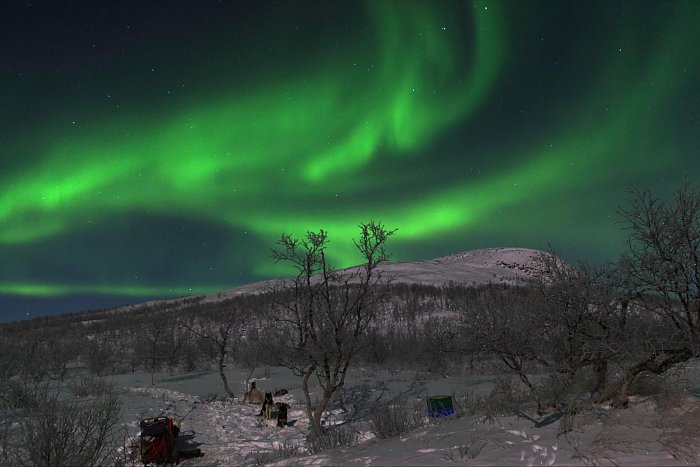
The northern lights come from particles sent out by the sun. They are drawn toward the poles and light up when they hit the upper layers of the atmosphere. Usually the light is green, sometimes with red shimmers. The higher the activity on the sun’s surface, the stronger the display.
Three things have to be true at the same time. The sky must be dark. The sky must be free of cloud. And the sun must be active enough to send something our way. The darker the sky, the better, which is why the dark season is what makes the lights visible at all. Moonlight is a mixed blessing: a bright moon turns the snow silver, but it also washes out faint auroras.
None of this can be booked. A week of overcast weather happens. A week of clear skies with a quiet sun happens. What you can influence is where you are and for how many nights, and that is where a sled tour differs from an evening excursion.
Why several nights in the mountains matter
An evening trip gives you one window of a few hours, on one date. A multi-day dog sledding tour gives you four to seven nights in a row on the shorter tours, more on the long ones, in cabins and tents where the only light is the stove and your headlamp. Every clear night is a chance. The detailed program for the Expedition Dividal notes plainly that photographers have a good chance of catching the lights on a clear night. We do not drive at night. But you sleep out in nature, in a cabin or a tent, so on a clear evening you can put on snowshoes or simply walk around the camp for a better view of the sky.
With the dogs we get far into the mountains in winter, where few others go. Around the Dividal and Rohkunborri national parks you rarely meet other people, so there is no light pollution to compete with. In the valley at the farm the situation is the same: eight inhabitants do not light up a sky.
The darkest weeks, and our northern lights tours
The darkest time of the year is around 21 December. The sun does not rise above the horizon, but we still have about four hours of daylight a day, which is enough to reach the next cabin, and the snow reflects every bit of light so it feels brighter than people from central Europe expect. This is when the lights have the most hours of dark sky to show themselves.
In this period we offer our northern lights tours, the Husky tour Northern light. It is a 5+3 or 8+3 day tour for beginners in good physical shape, level 1, in the birch forest and mountains around Lake Altevatn, with nights in cabins. Each day we move to the next cabin or make day trips from camp. The tour is not planned in detail in advance, so the group can reorganize along the way according to the weather and the participants’ wishes. The long evenings in the cabins are part of what makes it work. In the 2026/27 season it runs 14 to 21 December 2026 and 5 to 12 January 2027; current dates and places are always on expedition dates and booking.
Later in the winter the days grow longer and the nights shorter. The lights can still appear in February and March, but the window each night is smaller, and from mid-June we have midnight sun and no northern lights at all. If the lights are high on your list, the dark months are the ones to look at. If the sledding is high on your list, every month from mid-December to early May works, and the lights become what they should be: a possible bonus.
What the tour itself is
We do not sell northern lights. We sell dog sledding in expedition style, and the lights come or they do not. On every tour you drive your own team of five to eight dogs for the whole trip. There are no snowmobiles for breaking trail or carrying gear; everything the group needs is on the sleds. The group is never larger than six. Anne or Morten, the owners, lead every tour. Multi-day tours are the farm’s main business, and we have run them for almost 40 years, since Bjørn Klauer started the farm in 1988. Anne and Morten, Bjørn’s son, took over in 2020.
The tour begins with a full preparation day on the farm: getting to know your dogs, learning to anchor, brake, and steer, a practice run with your own team, a safety briefing, an equipment check, and packing the sleds together. Then the days in the mountains follow, with nights in simple cabins heated by wood stoves, in our lavvu 30 kilometers from the farm, or in heated winter tents when the route calls for it. Food is cooked from what the farm and the region produce, down to the sourdough bread from our own stone oven. How we think about all of this is on our tour philosophy.
The tours are strenuous. You need the fitness for a cycling tour with luggage in hilly terrain, you help the dogs on climbs, and you fetch wood and water at the cabin. No previous sledding experience is required, and we take guests between 16 and 65. What you should know before booking is collected under what you should know for a husky tour.
Watching and photographing the lights on tour
A few practical things, learned over many winters. The lights are easiest to see from the cabin door or the camp, not from a moving sled, so the evenings are your time. Dress as if you were going sledding; standing still in the cold is colder than driving. Our equipment list asks for a headlamp with spare batteries and a camera with spare batteries for a reason: cold drains both fast, and a powerbank kept inside your jacket helps. Rechargeable headlamps without a replaceable battery mean bringing two. The full list is under equipment needed for the expedition.
Do not plan your sleep around the lights. The dogs need you rested in the morning. Step outside before you go to bed, look up, and go back in if the sky is gray. On a long tour there will be another night.
Nights where you sleep, and what they are like
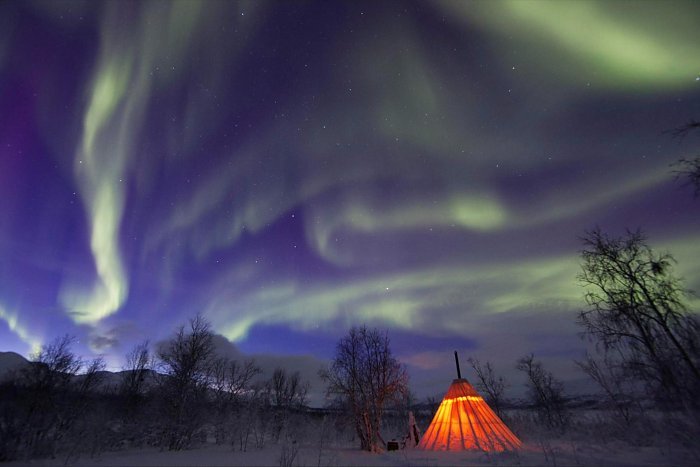
Before and after the tour you sleep on the farm, in the guesthouse or a holiday apartment. On tour, the cabins have wood stoves but no electricity, which is good news for the sky. Water comes from a hole in the lake ice or from melted snow. The lavvu has a wood stove and raised sleeping platforms. Tents are heated, with sleeping pads and reindeer skins against the ground, and you always sleep in a sleeping bag rated to about minus 30 degrees Celsius. Stepping out of a warm tent into a clear, silent night is where the lights are at their best, if they are there.
If the weather is good and you want to challenge yourself, you can also sleep under the open sky outside the tent or cabin: in a warm sleeping bag, on a good sleeping pad and a reindeer skin, with nothing between you and the sky. If the northern lights come out that night, you watch them dance above you from your sleeping bag. Details under accommodation on husky expeditions.
Frequently asked questions about dog sledding and northern lights
Will I see the northern lights on a dog sledding tour?
Maybe. You need a dark sky, no clouds, and solar activity, and we can guarantee none of them. What a tour gives you is several nights in a row far from any town light. A week in December or January gives you the most hours of dark sky. A week of cloud gives you nothing, and we will not tell you otherwise.
Which tour has the darkest nights?
The Husky tour Northern light in December and early January, because the darkest time of the year is around 21 December and the nights are longest. Any tour until March still has dark nights. From April the evenings get light.
Is the dark season too dark to sled?
No. Even around 21 December there are about four hours of daylight, and the snow reflects the light. It is enough to reach the next cabin every day.
Can we go out at night to see the lights?
We do not drive the dogs at night. But you sleep out in nature, in a cabin or a tent, so on a clear night you can walk around the camp on foot or on snowshoes. And if the weather is good and you want to, you can sleep under the open sky outside the tent or cabin.
Do you offer a short northern lights trip without the sledding tour?
We offer a three-hour day tour with your own team from the farm, and winter holiday weeks on the farm for adults and for families with guided sledding days. Those are daytime activities. The multi-day expeditions are the tours where you spend the nights out in the mountains.
What should I bring for the lights?
What you bring for the sledding, plus a headlamp with spare batteries, a camera with spare batteries, and a powerbank kept warm inside your clothing.
When is the season?
We run tours from mid-December to early May. Dates, levels, and availability are on expedition dates and booking.
The next step
If you want a winter week where the dogs and the mountains are the reason to come and the northern lights are a possible bonus on top, look at the Husky tour Northern light on its tour page and at the dates. If you have questions about light, timing, or which tour suits you, call Morten on +47 452 05 095 or write to info@huskyfarm-innset.no. We will tell you what we can promise, which is the sledding, and what we cannot, which is the sky.
 Facebook