
On our dog sledding holidays in Norway nothing is served to you on a plate: you are part of the expedition team. The guide leads the way, and from the first morning in the mountains to the last you drive your own team of five to eight dogs behind them, harness and feed your dogs, get them over the passes, and take your share of the work in camp, from carrying gear to fetching water and firewood. A full preparation day on the farm teaches you how. The tours last five to 28 days in the border mountains between Norway and Sweden, with at most six guests, no snowmobiles, and nights in cabins, a lavvu, or a heated tent. It is demanding, and that is the point.
Huskyfarm Innset sits at the end of a 35 kilometer dead-end road, 300 meters above sea level on the shore of Lake Veslevatn in Bardu, Troms. Eight people live in Innset. Across the lake stands Rubben, 1,024 meters, and behind the farm the Dividal and Rohkunborri national parks open onto one of the largest untouched areas of Arctic wilderness on the European mainland. Bjørn Klauer took over the run-down mountain farm in 1988. His son Morten and Morten’s partner Anne run it today, and one of them leads every expedition.
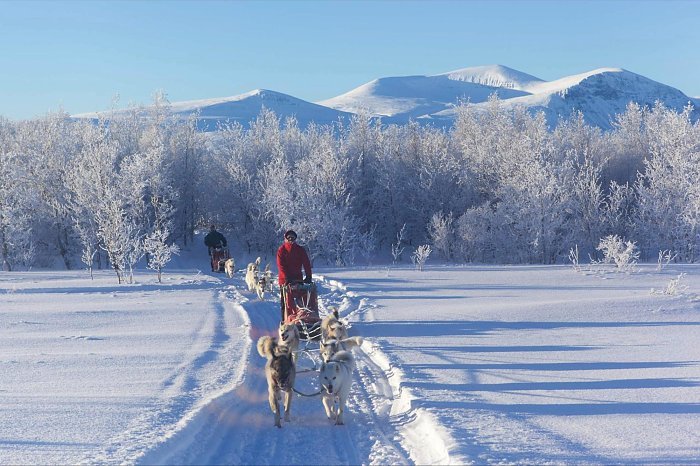
What “your own team” means in practice
On our tours you are not a passenger. We have run multi-day expeditions here for almost 40 years, and on every one of them each guest drives a team of their own. Every participant gets their own team and keeps it for the whole tour. You harness your dogs in the morning, drive them through the day, unharness and feed them in the evening, and you are responsible for them. The guide drives ahead and sets the direction. You follow with your team. All supplies and equipment needed for the expeditions are carried on all sleds. This means every guest also has a share of common equipment on the sled. On a 10-day trip, the sledges are heavy at the start, and that is how it is on an expedition. This is what makes the difference from an easygoing tour with supplies from snowmobiles.
We do it this way because, in our experience, it is the only way the unity of person, dog, and landscape becomes real. You learn what your dogs can do, you learn what you can do, and you find out where the limits are in a winter landscape that sets the rules. Till Gottbrath, an outdoor journalist who visited us, put it this way: “Die Hunde setzen dem Naturerlebnis die Krone auf”, the dogs are the crowning touch to the experience of nature. That is a result of running the tours without technical aids, and of each guest having a team of their own.
How many dogs run in front of your sled depends on how much weight you can put on the brake, on the weight of the sled, and on the snow we expect. On expedition that is usually five or six dogs for women and six to eight for men. The rule of thumb: the longer the tour, the more dogs. Read more about how we think on our tour philosophy.
Day one and two: arrival and the preparation day
Day one is arrival. You fly from Oslo to Bardufoss and take the free airport shuttle to Setermoen, or take the bus from Tromsø to Setermoen, around three hours. We pick you up at the bus station in Setermoen, and over dinner in our restaurant we go through the first details of the tour. How to get to us by plane, train, Hurtigruten, or car is on how to get here.
Day two belongs entirely to preparation, and it is mandatory. After breakfast everyone is assigned a team, so that you and your dogs can get acquainted before anything serious happens. Then comes the introduction to sledding: which dog goes where, what the lines are for, how to anchor the sled, how to brake, how to steer with your body weight. You practice harnessing and hitching, and then everyone takes a practice run with the guide, each with their own team. Over lunch in the restaurant, we answer the questions that always come up afterwards.
In the afternoon, the guide goes through safety: what to do in an emergency, how the group behaves in bad weather, and the route on the map. Then we check your clothing and equipment piece by piece. If something is missing, our clothing room fills the gap. We lend warm overalls, winter boots, and an outer sleeping bag free of charge. Finally we pack the sleds together, distribute the shared equipment, and go through where everything is. The day ends with dinner. The full program is described under safety first.
A day on tour
A tour day starts with breakfast, feeding the dogs, and packing the sleds. Then you harness your team, the guide releases the first sled, and the dogs go. In the first minutes there is a lot of pulling and barking. After that they settle into a steady trot, and you have time to look up.
We run in expedition style: no snowmobiles for breaking trail or carrying gear. Everything the group needs is on the sleds. That lets us adapt the route each day to the weather, the snow, and what the group can do. How long a stage takes varies a lot with the conditions. In the Dividal area there are cabins about a day’s travel apart. On steep climbs you help your dogs, running beside the sled or pushing it. On steep descents through forest you need concentration, your weight, and the brake.
At the day’s destination the dogs come first. They are unharnessed, tied out on the line and get a well-deserved cuddle as a thank you for the hard work. Then the stove is lit, water is fetched from a hole in the lake ice or made from snow, and dinner is cooked. On tour we are a team. Everyone pitches in, and nobody reaches the cabin on their own. More on the tours and their routes under our expeditions.
Where you sleep
Before and after the tour you stay on the farm, in the guesthouse or a holiday apartment with shower and kitchen. On tour we sleep in simple mountain cabins, in a lavvu, or in heated winter tents. The cabins have wood stoves but no electricity or running water. In Dividal National Park we like to use the cabins of the Norwegian Trekking Association, DNT, which stand a day apart along the border. On the Swedish side there are very simple Sami cabins, and at Altevatn and Leinavatn we have access through Camp Leina to good cabins with a sauna.
Thirty kilometers from the farm stands our lavvu, the cone-shaped tent of the Sami. Ours is modified with a wood stove instead of an open fire and raised sleeping platforms. Tent nights happen mainly on the longer tours. The tents are heated, and sleeping pads and reindeer skins keep the cold of the ground away. You always sleep in a sleeping bag, and our sleeping bag combinations are rated to about minus 30 degrees Celsius. The real problem in winter is not cold but moisture, which is why long tours head for a cabin every few days to dry boots and gloves by the stove. Details under accommodation on husky expeditions.
What you eat
Only the soup we eat on arrival at the cabin comes out of a packet. The sourdough bread with it is organic and baked in our wood-fired stone oven. Dinners are cooked fresh on tour or prepared in our restaurant beforehand and frozen, which is easy when you travel inside a very large freezer.
The meat comes from our own pigs and chickens, moose from local hunters, reindeer from Sami in the region, and beef, lamb, and goat from farmers nearby. Fish comes from the sea off our coast and from our lakes. We deliberately serve no salmon. The potatoes are our own, and in a good year there are cloudberries, raspberries, blueberries, and mushrooms from the surroundings. Vegetarian, vegan, and allergies are planned in if you tell us when you book. More under food and supplies.
Who these holidays suit, honestly
The tours are strenuous. You need the fitness for a cycling tour with luggage in hilly terrain. Average fitness is enough; below average is not. You will help the dogs on climbs, stand on the runners for hours, carry gear into the cabin, and fetch wood and water. You need no previous experience with dogs or sleds, and we take guests between 16 and 65. Cold, wind, and the occasional snowstorm are part of it. A storm is rare, but it happens, and with the right clothing it is a natural phenomenon rather than a problem.
To help you choose, our expeditions are divided into three levels:
| Level | What it asks of you | Tours |
|---|---|---|
| 1 | Fitness like a cycling tour in hilly terrain. You drive the sled yourself, harness and unharness, carry gear to camp, fetch water and wood | Husky tour Northern light 5+3 or 8+3, Husky camp Altevatn 5+3 |
| 2 | Like a cycling tour with luggage. Suitable for beginners, but with days of long climbs and rough terrain, helping the dogs uphill, more technical driving. Needs stamina, balance, and technique | Expedition Dividal compact 5+3, Expedition Dividal 8+3, Expedition Border Highland 6+3 (new this season) |
| 3 | Like a multi-day cycling tour with luggage. In practice you should have a multi-day sledding tour behind you. The difference from level 2 is length: more days and longer days | Expedition Dreiländereck 10+3, Special tour Kautokeino 11+4, Expedition Jukkasjærvi 10+3, Special tour Kebnekaise 13+3, Special tour Russian Border 26+2 |
The “5+3” means five days in the mountains plus arrival day, preparation day, and departure day. Everything from the official arrival day to the departure day is included: meals, accommodation, dogs, sleds, shared equipment, transfer from the bus station in Setermoen, reindeer skins, and snowshoes. You arrange your own journey to Setermoen. Guests with plenty of winter outdoor experience can start at level 3, but our advice is to take the levels in order. What else you should know is collected under what you should know for a husky tour.
The dogs you will be driving
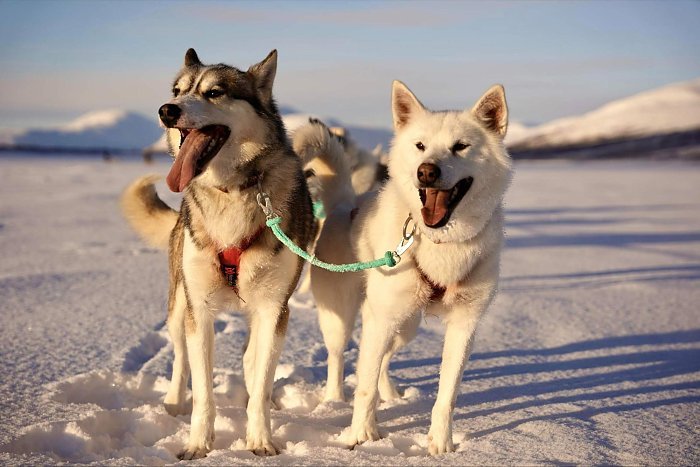
Our dogs are a mix of Greenland dog and Siberian husky, some with Alaskan husky. They are expedition dogs, not racing dogs: robust, a little larger, built to reach the next cabin whatever the snow depth. Speed is not what we ask of them. We have around 80 to 90 dogs. They are not guard dogs and have nothing to defend, so they greet every person who comes near. Young dogs start in harness at about 15 months. All of them live on the farm their whole lives. Meet them on our dogs.
Safety in the mountains
Every expedition is led by Anne or Morten. Both are owners, both speak Norwegian, English, and German fluently, both have known every dog since it was a puppy, and both know the routes, cabins, and snow conditions across the season because multi-day tours are our main business. We also share experience with our partner farm, Bardu Huskylodge of Ane and Jan in the neighboring valley.
In the mountains we are often without phone coverage and exposed to the weather. We always carry two tents and the equipment for an emergency camp, so we can sit out a storm safely. For emergencies and weather updates we carry a satellite phone, a PLB emergency beacon, a Garmin inReach, two GPS units, spare batteries, and a comprehensive first aid kit. Good travel insurance is your part. Every tour we announce runs regardless of how many guests have booked.
Frequently asked questions about dog sledding holidays
Do I need experience before I come?
No. The preparation day teaches you to drive, and the guide is with you the whole tour. Most beginners are in their element faster than they expected. What you do need is fitness, a willingness to work, and the ability to adapt to weather and snow.
How many dogs will I drive?
Usually five or six for women and six to eight for men, depending on your weight on the brake, the sled’s weight, and the snow. The longer the tour, the more dogs.
Can I come on my own?
Yes. Many of our guests travel alone. The group is never larger than six, and after the preparation day everyone knows each other.
What if I cannot manage my team?
That is what the preparation day and the practice run are for, and the guide is always within reach on tour. Driving a team on these tours turns out to be less difficult than most people fear, because the guide drives ahead of you and sets the pace and direction.
How hard is it really?
Hard enough that you should be honest with yourself about your fitness. Think of a cycling tour with luggage in hilly terrain, in cold weather, with physical work at both ends of the day. Kay Spanger wrote after his tour, in the words on our site: “Noch anstrengender als befürchtet, noch mehr Abenteuer als erträumt”, more strenuous than he feared and more adventure than he had dreamed of.
Which tour should I choose first?
Level 1 or 2: Husky tour Northern light, Husky camp Altevatn, or Expedition Dividal compact. All are designed for beginners in good shape.
When do the tours run, and what do they cost?
From mid-December to early May. Dates, availability, and prices are always current on expedition dates and booking.
The next step
If a holiday where you are responsible for your own team sounds right, look at the dates and read the detailed program of the tour that interests you. If you are unsure which level fits, call Morten on +47 452 05 095 or write to info@huskyfarm-innset.no. We will tell you plainly which tour suits you, even if it is a different one from the one you asked about.
 Facebook